

Launched in 2022, the Students Reinventing Cities Challenge empowers young innovators in C40 cities to design sustainable, inclusive and climate-responsive urban masterplans.
Eleven world-leading C40 cities – Amman, Barcelona, Freetown, Istanbul, Jakarta, Johannesburg, Lisbon, Milan-Segrate, Quito, Rome and Tshwane – seek students’ solutions to reimagine urban areas into green and thriving neighbourhoods.
In 2025, Community Jameel and C40 Cities, in collaboration with the Greater Amman Municipality (GAM), launched the Jameel C40 Students Reinventing Cities Challenge.
Focused on urban spaces in Amman, Jordan, the challenge is a unique opportunity for students to engage with real-world urban challenges and contribute to the future of sustainable cities.
The 2025 Jameel C40 Students Reinventing Cities Challenge is focused on Amman Southern Gate, a key site in the city's new urban planning strategy. Situated at the crossroads of Airport Road and Madaba Road, the area consists largely of undeveloped land parcels and offers a significant opportunity for sustainable urban transformation.
Over 170 students across 31 teams from universities in Egypt, Jordan and Italy brought forward innovative ideas to help shape a new masterplan for Amman Southern Gate.
The aim of the challenge was to transform the area into a vibrant, green neighbourhood that delivers a high quality of life for all residents.
Students were encouraged to submit proposals that champion sustainability, inclusivity and economic viability, and must align with the principles of climate-responsive urban planning.
Participants were asked to submit a 10-page proposal, including clear explanations and justifications for each element of the plan, supported by maps, diagrams and sketches that reflect both innovation and feasibility.
The winning team and eight special mentions were announced at an official ceremony co-hosted by C40 Cities and Community Jameel in collaboration with the Greater Amman Municipality (GAM) on 21 August 2025, under the esteemed patronage of His Excellency Yousef Shawarbeh, Mayor of Amman.
Team members: Sama Abdelghany, Merna Amin, Clara Ishak, Sara Osman, Jolie Olwy, Mariam Ezzat, Donia Mostafa, Merna Gamal, Catrin Ishak (Helwan University, Egypt).
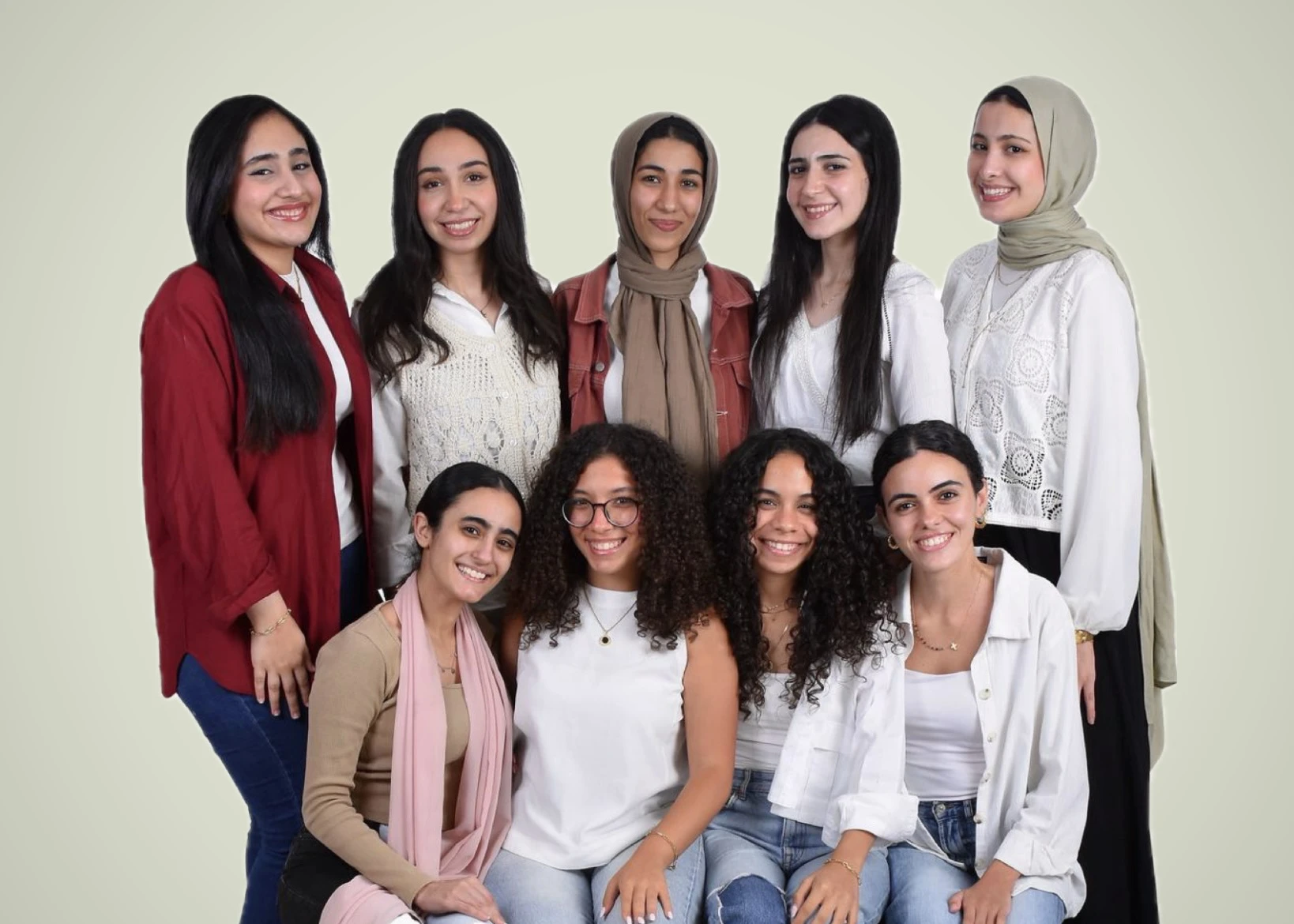
Urban Purifiers' proposal, titled 'وَصل WASL', transforms the streets of Amman Southern Gate into "living systems" through sustainable mobility and green infrastructure, with a design concept that addresses local climate change challenges, such as water scarcity and challenging topography.
To do so, the team put forward a ‘dynamic eco-pedestrian network’ to promote sustainable mobility and enhance urban quality of life through interconnected pedestrian routes featuring natural elements and responsive technologies - such as urban forest corridors, bioswales, rain gardens, green roofs and constructed wetlands. A major focus of the proposal is placed on community benefit and social cohesion, through cultural heritage integration, social interaction nodes and circular resource management principles.
Second place:
Third place:
Amman Southern Gate is a strategically located area that is vital in Amman’s urban planning framework. Positioned at the intersection of two major arterial roads: Airport Road and Madaba Road, the area serves as a gateway to the city, particularly for those arriving from the Queen Alia International Airport, while these two roads provide vital transportation corridors that connect the site to key areas within the city and the surrounding region.
The site has been designated as a Metropolitan Growth Centre, underscoring its potential to become a hub for economic, social, and infrastructural development in the southern part of the city. By selecting this location, the project aims to leverage its strategic position to facilitate sustainable urban expansion, improve connectivity and enhance Amman’s role as a vibrant and accessible metropolitan hub.
Amman Southern Gate presents significant development potential as 90% of site lands are open and unzoned, and the remaining 10% are storage houses and commercial buildings. Notably, one of the main landmarks within the site is the Jordan Zoo. Originally part of the broader Airport Road corridor initiative, a phase of the project was postponed. This delay provided an opportunity for a fresh perspective on the site's potential, enabling the creation of a landmark project that aligns with Amman’s strategic vision for growth and modernisation.
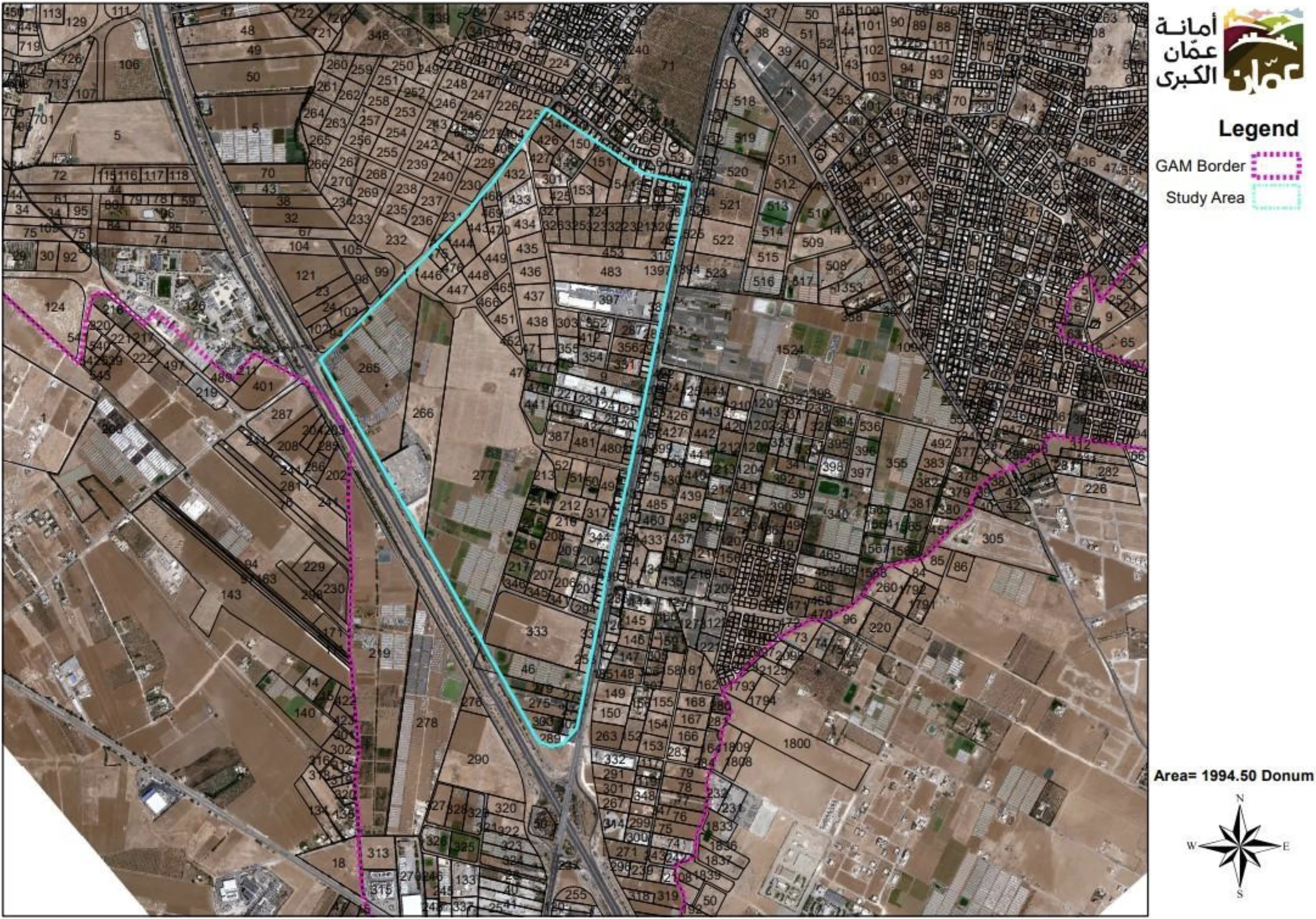
Approx site area:
The study area is 1994.50 Dunam/ 200 hectares
Key information:
Amman Southern Gate is located in the Khreibet Al-Souq, Jawa, and Al-Yadouda districts, which have a total population of 224,571 residents, according to the 2023 census.
Priority areas & main expectations:

Team members: Salam Mahmoud Ahmed, Hadeel Adnan Al-Attily, Anas Hameed, Amaal Abdullah Abuzaid and Makarem Mahmoud Mohammed Hulail (Philadelphia University in Jordan)
Adviser: Islam Al Shafei, Assistant Professor
The team’s project enhances the site's accessibility, with entrances to the camp rehabilitated and pedestrian-friendly with controlled vehicular traffic introduced. The team integrated rainwater collection infrastructure to collect reserves for non-potable uses, and tactical urbanism measures, such as benches, and play facilities for children.
Special mention, second place: Urban Harmony (University of Jordan)
Special mention, third place: Eco City Designers (Al-Ahliyya Amman University)
Despite its central location, Jabal Al-Natheef faces impoverished conditions and is labelled as a "refugee settlement," an "unofficial camp," or simply "the Palestinian camp." Muhammad Amin Camp was first developed in 1948 with tent communities. Over the last 70 years, the camp has expanded to define the entire Jabal Al Natheef neighbourhood and hosts over 45,000 displaced peoples from Palestine, Iraq, Jordan and Syria.
The site is marked by overpopulation, a lack of infrastructure, and narrow or sometimes non-existent streets, as there are a series of stairs rather than roads to parts of the area in the outside world. Remarkably, despite these challenges, there has been no disintegration of community ties or the cohesive community structure, which is a living embodiment of the power of resilience and solidarity in the face of the negative impacts of these challenges.

Approx. site area:
The study focuses on the Muhammad Amin camp in Jabal Al-Natheef, covering an area of 82,254 m² within the 1,269,880 m² neighbourhood.
Key Information:
In 2020, the Department of Statistics estimated Jabal Al-Natheef's population at 45,263, and the camp at 5,884, with a density of 71,534.52 people/km².
Priority areas & main expectations:
The primary objective of this competition is to transform the area into a sustainable, inclusive, and thriving urban space. Proposed solutions should address the area’s challenges, whilst preserving the site’s unique identity, improving amenities, and fostering a sense of unity and shared responsibility. This includes:

Team members: Raghad Abu Hadbah, Majd Al-Hanini & Tala Al-Humsi (HTU Al Hussein Technical University)
External advisers: Eng. Ala Gammoh & Eng. Ayman Zeiter | HTU Al Hussein Technical University
The winning proposal concentrated on promoting a horizontal, rather than a vertical, flow of movement. To do so, the proposal reimagines the site by connecting two of the area’s zones through a new transport hub. The hub has entrances on both sides, integrating the hub to connect the taxi and bus terminals.
Key characteristics of the new hub include:
Special mention, second place: Team Idea (University of Jordan)
Special mention, second place: Team Evergreen (Zarqa University)
Special mention, third place: Team The Living Bridge (Zarqa University)
The Al Mahattah Hub was originally a simple, limited public transit station for public buses and service cars. It expanded when all transport lines (buses and cars) and shop owners working in the Raghadan terminal were transferred there as a temporary measure.
However, due to the time taken to reinvent the Raghadan terminal, Al-Mahatta transformed into a permanent hub for vendors and transport lines. Buses currently operate in a chaotic manner due to the commercial activity linked to the hub. transport system. The terminal currently raises serious concerns for the mobility and accessibility of pedestrians.

The competition site primarily includes the Al-Mahattah Bus Terminal, a major urban transport interchange in Amman with several lines of buses (including interurban, coasters, and feeder buses), taxis, a daily market, social services located around a mosque, and a buzzing urban centre. Passengers include commuters, shop owners, vendors, and public transport drivers.
The site also includes a BRT (Bus Rapid Transit) Line 1 connection terminal between Amman and Zarqa (25 km North-East of Amman). Proposals should aim to integrate the BRT connection terminal with the bus terminal to ease the movement and circulation of commuters. This will help create an integrated transport hub that will be a major connection point between BRT Amman and Amman Zarqa BRT and among other transport modes (such as taxis, feeder buses, and coaster buses).
Al-Mahatta area is surrounded by densely populated areas, especially those with limited and low incomes. Al-Mahatta area lacks public spaces and is currently not suitable for pedestrians to move around. The surrounding communities fall within national poverty lines, often facing high unemployment levels and limited job opportunities. The Refugee Al-Mahatta camp is also located near Al-Mahatta Terminal.

Approx. site area
83,000m2. The main focus of this site should be area (1 + 1b) taking into consideration the adjacent areas of (2+3+4) (Figure 1)
Key Information
There are 350,000 passengers that visit the terminal daily, and this is expected to double with the launch of the Amman Zarqa BRT.
Priority areas & main expectations